Lawn Renovation in Fall: Seeding & Overseeding Guide
Is this the right time to renovate your lawn?
Why late summer and early fall represent one of the best windows for turfgrass renovation
Late summer represents a critical stage in the management of turfgrass established with cool-season species. After weeks of high temperatures, intense evapotranspiration, water stress, traffic, and potential disease pressure, it is common to observe a loss of turf density, thinning areas, or sections of the lawn that are no longer able to recover uniformly.
However, not all of these symptoms require complete renovation.
Some turf areas may recover naturally as temperatures decline and active growth resumes. In other situations, however, the presence of bare areas, soil compaction, excessive thatch, or a high proportion of undesirable vegetation may make it appropriate to plan a renovation program or, in the most severely affected cases, a complete renewal of the turf surface.
The first question to ask, therefore, should not be “Which seed should I use?” but rather:
Why has the turf deteriorated?
Any agronomically sound intervention should begin with this diagnosis.
Why is this one of the best periods for seeding cool-season turfgrasses?
Cool-season turfgrasses, including Lolium perenne, Festuca arundinacea, and Poa pratensis, express much of their vegetative growth when temperatures become more moderate compared with peak summer conditions.
Late summer and early fall are generally among the most favorable periods for establishing new cool-season turf from seed. One reason is that young seedlings can develop during fall and subsequently benefit from spring growth before facing their first major period of summer heat stress. During this period, competition from many annual weeds is also generally lower than in spring.
From a physiological perspective, this seasonal transition creates a particularly favorable situation: air temperatures gradually decline while the soil still retains some of the heat accumulated during summer.
This means that seeds may encounter favorable germination conditions at the same time as the risk of newly emerged seedlings being immediately exposed to extreme temperatures begins to decrease.
However, it is important to avoid a common oversimplification:
Germination does not mean establishment.
Germination is only the beginning. After radicle emergence and the appearance of the first shoots, the young plant must develop a functional root system, produce new tillers, and progressively occupy the available space.
The real objective of fall seeding is therefore not simply to make the lawn look “green” as quickly as possible, but to establish a sufficiently developed turf canopy before limiting winter conditions arrive.
Before seeding, understand what went wrong
This is probably the most important stage of the entire renovation process.
Reseeding a lawn without correcting the underlying cause of its deterioration often produces a good initial result, only for the same problems to reappear a few months later.
Problems such as soil compaction, inadequate drainage, and unfavorable environmental conditions should therefore be identified and corrected before beginning a renovation program.
Soil compaction
Compacted soil has reduced pore space.
For turfgrass, this means less air circulation within the soil, less efficient water infiltration, and greater difficulty for roots to colonize deeper layers of the soil profile.
In these situations, simply applying new seed will not solve the problem.
Core aeration, on the other hand, can help alleviate compaction by creating new macropores and improving the ability of air, water, and roots to move through the soil profile.
Late summer and early fall can be particularly suitable periods for core aeration of cool-season turfgrass, provided the turf is actively growing and soil moisture conditions are appropriate.
Thatch
Thatch accumulation should also be evaluated before overseeding.
An excessive thatch layer can restrict the movement of air, water, and nutrients toward the soil and, most importantly, prevent seed from reaching the soil surface. Thatch can interfere with overseeding precisely because it reduces seed-to-soil contact.
This does not mean that turf should be dethatched every year.
The operation should be carried out when accumulation is genuinely excessive and during a period in which the turf has sufficient capacity to recover. Aggressive dethatching should be avoided during intense heat, drought, or excessively late in the fall.
Drainage and irrigation
A turf surface that appears “dry” may actually be affected by uneven water distribution.
Conversely, turf subjected to frequent waterlogging may develop shallow and inefficient root systems.
Before reseeding, it is therefore useful to check irrigation uniformity, identify any depressions where water may accumulate, and evaluate the soil’s ability to drain properly.
Shade and microclimate
Another common cause of turf thinning is incompatibility between the turfgrass species and the growing environment.
A heavily shaded area, for example, cannot simply be restored by increasing the amount of seed applied.
The duration of shade, light quality, surrounding trees, root competition, and water availability all need to be considered.
Genetic selection should follow this evaluation, not precede it.
Overseeding, renovation, or complete renewal?
These are three different interventions and should not be used as synonyms.
Overseeding involves introducing new seed into an existing turf that is still functional but no longer sufficiently dense.
Renovation, on the other hand, involves a more comprehensive set of operations: preparation of the existing turf canopy, possible dethatching or core aeration, seeding, fertilization, and irrigation management.
Complete renewal becomes a more rational option when desirable turfgrass represents only a minor proportion of the surface or when significant structural problems need to be corrected.
| Observed condition | Agronomic intervention to consider |
|---|---|
| Turf still uniform but less dense | Overseeding |
| Localized thinning | Localized renovation |
| Widespread summer damage but good presence of desirable turfgrass | Renovation |
| Severe soil compaction | Core aeration + renovation |
| Excessive thatch | Thatch management + overseeding |
| High proportion of undesirable vegetation | Renewal |
| Structural soil problems | Soil correction + complete renovation |
| Turf canopy almost completely compromised | Complete renovation |
This table should be interpreted as a general decision-making guide rather than as an absolute threshold applicable to every situation.
Soil preparation determines a large part of the final result
Seed genetic quality is important, but it cannot compensate for a poorly prepared seedbed.
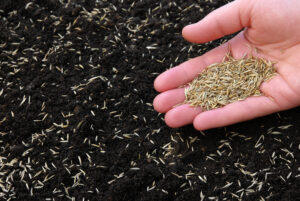
One of the most common mistakes when overseeding is to spread seed over the existing vegetation and leave it trapped between leaves and thatch.
The seed must reach the soil.
Seed-to-soil contact is a fundamental requirement for successful germination. When necessary, verticutting, core aeration, or specialized seeding equipment can be used to increase the likelihood that the seed actually reaches the soil surface.
It is a simple but critical principle.
A high seeding rate cannot compensate for poor seed-to-soil contact.
In other words, success depends not only on how many seeds are applied, but on how many of them are placed in conditions that allow them to germinate and develop successfully.
Before a major renovation, it may also be useful to carry out a soil analysis. Soil testing is one of the first steps to consider in renovation programs because it provides information on soil pH and any nutritional corrections that may be required before establishment.
Seed mixture selection must start with the site
The question “What is the best seed?” cannot be answered correctly without first defining the conditions in which the turf will be used and managed.
A seed mixture should be selected according to at least its intended use, climate, exposure, water availability, traffic intensity, maintenance level, and desired aesthetic result.
Lolium perenne
Lolium perenne is particularly valuable in renovation programs because of its relatively rapid germination and establishment compared with other cool-season turfgrasses.
This characteristic makes it particularly important on sports fields and other surfaces where recovery speed has functional importance.
Festuca arundinacea
Festuca arundinacea is one of the most versatile species used in modern turfgrass systems.
Cultivars selected specifically for turf use can develop dense turf canopies and, under favorable conditions, deep root systems, an important characteristic when greater tolerance to summer conditions is required.
Poa pratensis
Poa pratensis has an important capacity for vegetative recovery due to its production of rhizomes.
This characteristic enables the turf to progressively colonize surrounding spaces and recover damaged areas.
Its initial establishment is generally slower than that of Lolium perenne, however, and this should be taken into account when planning management during the first few weeks after seeding.
Using a seed mixture makes it possible to combine different characteristics, but the percentages and cultivars included must follow a clear agronomic rationale.
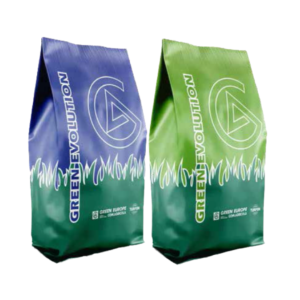
Choosing the right seed mixture is therefore a critical factor in the success of a renovation program. The professional Blue Line and Green Line ranges include different combinations of species and cultivars designed to meet specific requirements in terms of intended use, site exposure, and maintenance intensity. Discover our turfgrass seed mixtures and identify the solution best suited to the characteristics of your turf.
How to distribute seed correctly
On regular surfaces, a good practice is to divide the total amount of seed into two equal portions.
The first half is distributed in one direction and the second perpendicular to the first.
This technique helps improve distribution uniformity across the surface.
After seeding, seed-to-soil contact should be encouraged through light raking, rolling, or the use of specialized professional equipment.
The purpose of rolling is not to heavily compact the soil. Its role is simply to improve contact between the seed and the soil surface.
Seeding depth also requires attention.
Turfgrass seeds are generally small. Burying them too deeply can delay or even prevent emergence.
Fertilization at seeding: supporting the young plant
The establishment phase has different requirements from those of mature turf.
Initially, the seedling relies on the reserves stored within the seed. It must then rapidly develop a root system capable of exploring the soil and sufficient leaf area to support photosynthesis.
Nutrition should support this transition.
Within the Green Europe program, POP-UP 16-30-5 can be used as a starter fertilizer at seeding when soil conditions and the agronomic program justify its application.
The product supplies nitrogen, phosphorus, and potassium in a formulation designed to support the initial establishment phase.
However, the correct order of priorities should always be maintained:
soil preparation → seed → seed-to-soil contact → water → nutrition
Fertilizer cannot compensate for mistakes made during the previous stages.
Irrigation after seeding changes as the plant develops
Water management is one of the most delicate aspects of establishing new turf.
The general principle is simple: during germination, the seed needs a sufficiently stable level of moisture.
It is important to keep the seeded area moist until germination and until the young seedlings become well established. The same principle applies to recently overseeded areas.
This does not mean keeping the soil saturated.
During the initial phase, light and relatively frequent irrigation is generally required, adjusted according to temperature, wind, exposure, and the soil’s water-holding capacity.
As emergence occurs and the root system begins to develop, however, the irrigation program should progressively change.
Frequency is reduced while the depth of wetting is increased.
This transition is fundamental. Maintaining shallow, frequent irrigation for too long can encourage the development of a shallow root system.
Germination is only the beginning
When the first green shoots appear, it is easy to assume that the work has been completed.
In reality, this marks the beginning of another particularly delicate stage.
The new plant must progress through a series of developmental phases: germination, emergence, root development, production of new tillers, initial mowing, and progressive consolidation of the turf canopy.
Timing varies considerably between species.
Lolium perenne generally germinates more rapidly, while Poa pratensis requires more time.
This means that, within a seed mixture, the appearance of the first seedlings does not necessarily indicate that all components have already emerged.
Changing irrigation practices too early may therefore penalize species with slower germination.
The first mowing
The first mowing should not be considered simply an aesthetic operation.
It is one of the first management practices involved in developing the new turf.
The turf should be allowed to reach sufficient development, and the soil must be firm enough to support the operator or mowing equipment without deformation.
The mower blade must be perfectly sharp.
Young plant tissue can be easily damaged by an uneven or tearing cut.
It is also important to avoid removing too much height in a single mowing operation. The first cuts should gradually bring the turf toward its intended management height.
The mistakes that most often compromise fall seeding
Most establishment failures are not caused by a single factor.
They are often the result of several small mistakes occurring together: seeding without an initial diagnosis, poor seed-to-soil contact, irregular irrigation, an incorrect seeding rate, or carrying out the operation too late in the season.
Timing is particularly important.
“Fall seeding” does not mean that turf can be seeded indiscriminately at any point during the fall.
The correct window should be evaluated according to geographical location, altitude, turfgrass species, and actual weather conditions.
Renovating turf means correcting the system, not simply applying new seed
A deteriorated lawn cannot be successfully restored simply by replacing the vegetation visible at the surface.
Turfgrass is the result of the interaction between plant, soil, water, microclimate, and management.
If one of these elements is strongly limiting, even the best seed mixture will only be able to express part of its genetic potential.
For this reason, a professional renovation program should follow a logical sequence:
diagnosis → correction of limiting factors → preparation → genetic selection → seeding → water management → nutrition → establishment
Skipping one of these stages increases the risk that the result will only be temporary.
Frequently Asked Questions
The most common questions about turfgrass renovation and seeding during late summer and early fall.
Is September really a good time to renovate a lawn?
For many cool-season turfgrasses, yes. Late summer and early fall are generally considered among the most favorable periods for seeding because young seedlings can develop under more favorable temperatures than during summer and continue to establish before and after winter.
Is it always necessary to completely renovate the lawn?
No. When a good proportion of desirable turf is still present, renovation or overseeding may often be sufficient. Complete renovation becomes more appropriate when the surface is severely compromised or when significant structural problems need to be corrected.
Should core aeration always be carried out before overseeding?
No. It is particularly useful on compacted soils. It can also improve seed-to-soil contact, but it should not be considered mandatory in every situation.
Can seed be spread directly over the existing turf?
Technically, yes, but the chances of successful establishment increase significantly when the seed is able to reach the soil. Seed-to-soil contact is one of the key factors affecting germination.
When should I start reducing irrigation frequency?
When seedlings begin to develop a more functional root system. The transition should be gradual: moving from shallow applications required during germination toward less frequent and deeper irrigation.
What is the best turfgrass seed mixture?
There is no single best mixture for every situation. Selection should depend on intended use, exposure, climate, water availability, maintenance level, and the desired final result.
In conclusion: is this really the right time?
For many cool-season turfgrass systems, yes.
However, the seasonal advantage should not become a reason to seed without first analyzing the condition of the existing surface.
The success of a renovation program does not depend solely on seed quality. It depends on the ability to identify what limited the previous turf and correct those factors before asking new seedlings to establish.
The right timing matters. But creating the right conditions matters even more.
This is the difference between simply reseeding an area and carrying out a true agronomic turfgrass renovation.
To identify the most suitable seed mixture for the intended use, site characteristics, and expected maintenance level, the Green Europe Comagricola technical team can support professionals and turf managers in defining the most appropriate seeding and nutrition program.